The only program for small animal massage professionals who want better neuro results

Help dogs with IVDD, laryngeal paralysis, and other nerve-related issues move and feel better - all while you expand what you can offer and build real confidence in handling challenging cases
  • Proven nerve techniques to improve function & quality of life
  • Step-by-step training so you know exactly when & how to apply them
  • Live coaching & expert support to ensure you implement with confidence
ASN text logo

I'm Lisa - animal bodyworker, educator, and science geek.

When I first trained in animal massage, I was taught that there wasn’t much we could do for neurological conditions. I heard it so many times, I started repeating it to clients: Massage is great for muscles, but nerves? ...I can help with compensation. It was frustrating.


Then my own dog, Fergus, developed IVDD. Suddenly, that frustration turned personal. Medication, acupuncture, and rehab kept him going, but I hated the feeling of helplessness - of not being able to do something with my own hands.


So I started looking for answers.
But when I searched for nerve-focused bodywork techniques for animals, I found… nothing.
There were clues… The first time I tried a nerve-focused approach, it was with a dog named Brady. He had IVDD, and his back end dragged when he walked in. I avoided his spine (as I was taught), did some tentative nerve stimulation, and watched in real time as he walked out with a level topline and proper foot placement. That moment changed everything. I was on a mission.


It wasn’t that the science wasn’t there - human therapists had entire courses on nerve mobilization, neurovascular work, and nerve stimulation. So I took those courses. I studied how nerves move, how they get trapped, and how freeing them up can create real functional improvements. And then, I got to work figuring out how to apply those concepts to animals.


The results? Better than I expected.


Now, a large majority of the neurological cases I see - dogs with IVDD, geriatric onset laryngeal paralysis, post-surgical weakness, and more - show improvements in function using these techniques. Even stubborn musculoskeletal issues shift when I address the nerves.

I still do not know exactly how any individual dog will respond. That is why I teach you to assess what you are seeing, try an appropriate technique, and retest. With progressive conditions, the goal may be helping the dog function as well as possible for as long as possible, not reversing the disease.


This approach isn’t just another “tool in the toolbox.” It’s a missing piece in animal bodywork.


Paired with veterinary care, physical therapy, and other modalities, it helps create more complete, long-term care plans for animals who need it most. Better outcomes and happier lives for animals means they keep rebooking (for me, many dogs stay with me for life!), you get more referrals, you can be more confident in your marketing.


If you’ve ever felt stuck, wishing you had more to offer animals with neurological challenges, you’re not alone. And the good news? There’s more we can do than we were taught.
I’m Lisa Ruthig, a mentor at Power of Touch for Animals. I was Director of Animal Programs at Bancroft School of Massage Therapy and Chair of the National Board of Certification for Animal Acupressure and Massage. Currently, I teach equine massage at Animal Bodywork Academy of New England.

I have a massage practice for small animals and equines, and do energy work, as well. My personal mission is to make sure that every animal that needs bodywork, gets bodywork. It is my honor to guide and train other animal bodyworkers to provide quality work to their clients.

I have a passion for science and love to know why my mojo works. I like to break down complex topics into simple concepts applicable to your work.

Lisa and her dog Fergus

With ASN, in just 12 weeks, here's where you could be:

Over the 12 weeks, you'll build the knowledge and hands-on skills to assess what you are seeing, choose appropriate nerve techniques, and measure changes in balance, gait, and everyday function.

When owners can see and understand the difference your work is making, they have a clear reason to continue with you and tell others about you.

With a new suite of nerve techniques in your toolkit, and new confidence with the kinds of cases you used to have to turn down, you'll be able to support more animals, get more word of mouth referrals, and build longer-term client relationships.

Here's how it works. ↓

Introducing
ASN logo

Help dogs with IVDD, laryngeal paralysis, and other nerve-related issues move better and feel better

Bitesized, step-by step-training | Live coaching | Proven techniques | Expert support

Hear from our students

< Scroll for more>

Author

I had a couple of clients with Intervertebral Disk Disease (IVDD) in the past, and there were minimal massage techniques I could offer. This course taught me nerve techniques that I can apply to my future cases. Lisa is an excellent instructor and very responsive. Lisa breaks down complex scientific concepts into understandable pieces. The class was fun, and I highly recommend it. Thank you, Lisa! 

Tünde Cser
CSAMP
Author

I have been working with geriatric clients for some time, and while there are many benefits from the modalities that I use, I was not always satisfied with the results when it came to neurological symptoms. I enrolled in 'The Art & Science of Nerves' taught by Lisa Ruthig and it opened up a whole new field of possibilities to enhance my work and make a difference for my clients. Her course is in-depth, regarding both science and its practical application. She also provided a tremendous amount of helpful information regarding materials and client information to use in the future. I have already seen the difference I can make by using the techniques I learned and highly recommend the course. I love that that the knowledge I gained can be incorporated in what I already practice and will therefore enhance my work. 

Helga Karisch
SAMP LAMP SAAP
Author

The course not only gave me more tools to work with dogs with challenging neurological issues, but it also gave me insight and confidence to work with nerves. The course was very well done and I could go at my own pace to grasp the techniques and material. The bonuses were great and overall, I got a lot out of ASN. 

Before taking this course, I was working with a dog that had lameness issues. She saw me every other week in combination with chiropractic care. She seemed to plateau and remained unable to enjoy activities as she once had. She was the first dog I worked with using the nerve techniques and it worked wonders. The owners called later that day to report amazing results. Their dog was walking on all 4 legs without any issues and is back to running and playing with other dogs. I'm so glad I took this course! 

Lisa Breger
CSAMP
Author

Working with neurological cases can at times feel confusing as there are many symptoms and so many possible causes. Taking this course helped me take a step back and put on a 'scientist hat': try this then record the result, observe, experiment, record. I found this extremely helpful in planning out my future sessions. I have incorporated the techniques learnt and I am already seeing results! Very highly recommended. 

Marta
All Paws Massage
Author

Before ASN as a canine PT I was pretty confident in my skills to help neurological clients, but my confidence has improved even more with knowledge and skills gained during this course. Lisa makes complicated topics easy to understand. The coaching calls and forum give you plenty of opportunity to ask questions and not only learn from Lisa, but also from others in the course. I have already seen accelerated progress using the techniques covered in this course! This course would be great for anyone working in animal rehab or body work who wants to enhance their manual skills to assist dogs with conditions affecting the nerves or those with mobility issues. 

Dr. Courtney White
DPT, CCMFT, CCRT
Author

I have been using the techniques with my client dogs, especially Maddie, the dog with degenerative polyneuropathy. Maddie has seen remarkable improvement. After implementing these techniques, she is now able to walk up hills in her yard and play with their other dog. She has even been able to play ball with her dad!  Maddie has more stability in the rear than she has ever had, and her quality of life has greatly improved.

Elisha Edge
NCCMT, CSCC
Author

Prior to participating in the Art & Science of Nerves, I felt inadequate in both my knowledge of nerves and my ability to directly support my massage clients who were presenting with nerve issues. Lisa makes the science piece accessible, through her clear and thorough information and visuals. Her videos working with the animals were also 'real life' and she was able to demonstrate on animals that were wiggly, and discussed modifications as needed. I appreciate this wonderful opportunity! 

Susie Sarachman
Hands for Harmony
Author

The Art & Science of Nerves course was a real eye opener for me! I've had clients as well as my own dogs that have suffered with some form of neurological conditions that I felt massage could only help very temporarily and if given more frequently and sometimes massage felt superficial to the overall care plan. With the new techniques (and there are many) I learned in this course I feel so much more confident in helping these clients be their best selves given the afflictions they may have. Lisa did an incredible job providing background for several common nerve pathologies and their symptoms while teaching effective techniques for working on these conditions in your clients. There is plenty of bonus content as well. I am really excited to take these new tools and add them to my sessions! 

Dianne Cykert
Author

I really loved this class and am so glad I took it! Lisa is a fantastic teacher who really understands, and is able to teach, a variety of information about the nervous system and individual nerves. The class was extremely comprehensive, and Lisa was always available for questions and help. This class gave me a new understanding of how to work with some specific nerves, and how this work may positively effect certain kinds of issues. Having more information about how to work with nerves is a new tool and skill I am excited to incorporate into my practice. The clients I have talked to about this class are just as excited for me to try my new skills with their dogs. It's a win-win! I highly recommend this class!

Katie Mehrtens
Author

I signed up for this course because I wanted to have a deeper understanding of the nervous system and how I can help my own clients gain mobility and function better without pain. The graphics were excellent and the material was well-researched and presented in a way that I could understand and apply what I had learned. I love Lisa's teaching style and I appreciated learning through the input of other classmates. I highly recommend this course for animal practitioners, therapists and bodywork professionals. 

Terri Schmidt
Author

The wonderful content that built upon itself was incredibly helpful and I will apply it as I encounter animals who could benefit from it (although, there is a ton that would benefit all of my clients). This course also taught me, once again, that less can be more. The nervous system (and tissues) can be activated simply by touch, which can activate a marvelous set of benefits to the animal. Energy matters :-) 

Anonymous

Here's what you'll learn inside:

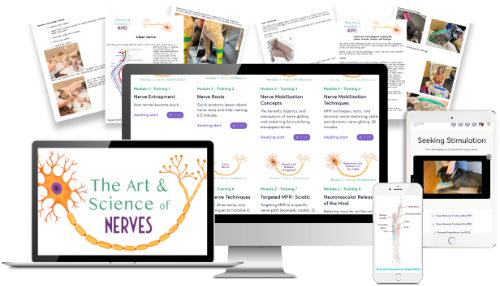
Module 1- Vagus Nerve Stimulation

Learn four simple techniques to stimulate the Wanderer to promote relaxation, increase appetite, and improve quality of life for your client. Improve the function of the Vagus nerve in conditions like geriatric onset laryngeal paralysis polyneuropathy. The effects range from very subtle to life-changing.

Module 2- Nerve mobilization 

Free up stuck nerves, with potential benefits for ataxic and partially paralyzed animals, as well as many musculoskeletal conditions.

Feel these techniques on your own body so you understand their power. Understand the underlying anatomy of major limb nerves and how to affect them with nerve gliding, nerve stretching, and myofascial techniques.

  • Sciatic nerve
  • Femoral nerve
  • Obturator nerve
  • Radial nerve
  • Musculocutaneous nerve
  • Ulnar nerve, and more!

Module 3- Limb Nerve Stimulation

Wake up weak limbs with stimulation techniques like kinesiology taping, so you can help your clients integrate their bodies and move better. 

  • Kinesiology taping for the major limb nerves and pudendal nerve
  • Joint compressions
  • Brushing
  • Sensory mats
  • Tail work

Module 4- Complaints and Conditions

Learn the pathologies you can most easily affect with nerve work. Deeper understanding of physiology will enhance your ability to apply the techniques and develop your own alternative strategies.

Module 5- Safe Alternatives to Back Massage

Worried about massaging the back in cases like IVDD, spinal tumors, and other possible contraindications? Learn a few safer ways to relieve back pain and relax the tissues without using pressure, including

  • Kinesiology taping
  • Several creative fascial techniques
  • Neurovascular release
Pre-recorded Skills videos

See the techniques performed on a variety of dogs (they work for cats, too!)

Theory when you need it

 As much A&P and pathology as you need to know how and when to safely apply the techniques, without getting overwhelmed. (Pre-recorded)

Live coaching

Three regular Zoom group coaching calls to discuss techniques, cases, and marketing.

Access to Course for the Lifetime of Power of Touch for Animals


For Certified Small Animal Massage Practitioners and Rehab Professionals (and qualified students)

Private Forum for Community


No Risk Guarantee: Full Refund within 30 Days of Class Start

Bonuses

Graduation cap

Neurology A&P Review

Optional lecture to refresh your knowledge of the nervous system in small animals, so you can hit the ground running.

Video player

Acupoints for Nerve Issues

Learn acupoints you can use to support your nerve work, by Nationally Board Certified Acupressure practitioner and past NBCAAM chair Kim Bauer.

Includes a quick review of acupressure with an exploration of the paravertebral points, with a case study and other useful points for neuro issues.

Graduation cap

Conversations with Clients

How to navigate the marketing language around your new skills. How to use stories, reviews, and testimonials to supercharge your connection with potential and current clients. And how to know what's legal to say in your jurisdiction.


Help dogs with IVDD, laryngeal paralysis, and other nerve-related issues move better and feel better

Bitesized, step-by step-training | Live coaching | Proven techniques | Expert support

  • 5 expert modules
  • Bitesized step by step training
  • Live coaching
  • Private forum
  • NBCAAM CE credit
  • BONUS 3 x monthly group coaching calls
  • BONUS Acupoints for nerve issues
  • BONUS Conversations with Clients

Your price= $697

or payment plan 3 x $245

Frequently asked questions

Who is this course for?

If you are a certified small animal/canine massage practitioner or a certified small animal rehabilitation professional, this course is for you. Students are also welcome if you're at a point in your studies where you've learned your hands-on skills.

When does it start?

The trainings are ready and waiting for you. The kickoff call is Tuesday September 22nd at 7pm Eastern. Coaching calls are monthly, currently the second Tuesday of each month, but can be adjusted according to the schedules of who is in the course.

Is this course NBCAAM approved?

ASN is approved for 14 hours of skills credit and 2 hours of general credit (and growing!) To claim skills hours, you will need to choose the assessment option and submit video. (Otherwise you will receive 16 hours of general credit.)

What's the time commitment?

The core recorded training is about six hours, with an additional five-hour library of recommended prior Q&A (and more optional Q&A recordings). The cohort includes three one-hour coaching calls.

I've designed this course with flexibility in mind. With pre-recorded materials, you can progress at your own pace. If you can't make the coaching session, send in your questions and view the recording. Or pop your questions in the forum. It's about fitting learning into your schedule, not the other way around.

Will online learning be as effective as in-person training?

In-person training is essential to initial massage training. Online learning can be effective if it builds on and recombines your basic skills. It's also flexible and accessible, allowing you to learn at your own pace, and you can return to videos over and over, unlike live workshops. 

Can I really make a difference for my clients with nerve techniques?

Yes - though what “making a difference” looks like depends on the dog and the condition.

Some dogs make significant functional gains. For others, especially with progressive or degenerative neurological conditions, the goal may be improving comfort, mobility, or quality of life, helping them maintain function longer, or simply giving them better support as the condition progresses.

I don’t teach nerve work as a cure. What I do teach is how to assess what you’re seeing, choose techniques that make sense, and measure whether they’re helping.

Most of my practice is now clients with neurological issues, and many of these animals see me regularly for life because their owners continue to see value in the work. The student testimonials on this page show the range of differences these techniques can make.


I'm worried about the course cost.

We have a payment plan to make the course more managable, and have made the individual assessment feature optional, if you don't need that, to keep costs down. Using these skills in my own practice provides animals and their families the sorts of results they are willing to pay for over and over.

How can I get my skills assessed?

You can either bring video to group coaching, which is included in the course, or purchase an individual assessment for $150, at the time of course purchase, or later.

What does lifetime access mean?

Lifetime access means you can return to the recorded course for as long as Power of Touch for Animals remains in business and continues to host the program. The 12-week cohort support, including the live coaching and body doubling sessions, is limited to the scheduled cohort period.

What if now is not the right time for me?

If the timing or investment is not right, you don't need to rush. The self-paced version of The Art & Science of Nerves is always available (and includes 3 coaching calls). 

NBCAAM CE Provider seal
EPM Certified Experience Product seal
Power of Touch logo

Copyright 2025 Power of Touch for Animals. All rights reserved. Cookie Policy Privacy Policy